Saturday, July 28, 2012

How to Publish a Website Manually in Yahoo Domains Hosting

Finding affordable web hosting these days is easier than it has ever been before. As more companies compete against each other trying to offer their users an array of features, options and perks the affordability of web hosting has never been better. One of the largest domain name and web hosting providers is still Yahoo, which offers hosting, domain names and a tier of low-cost web options for their consumers.


Instructions


Things You'll Need:


Yahoo Web Hosting account
Internet access
Computer
Website files
How to Publish a Website Manually in Yahoo Domains Hosting


Step 1
Log on to Yahoo Web Hosting account to upload files. Use the “Resources” link below to visit the login page for Yahoo Web Hosting. Left-click on the “Small Business” tab in the upper right-hand side of the screen; this will take you to a log in page. Enter your user name and password to log in and click on “Sign In.”


Step 2
Select the domain that you wish to upload files to. Depending how many domains you have, you may need to scroll to the domain that you wish to upload files to. There is an arrow button next to each domain on the left-hand side. Left-click on the arrow button to open the domain functions.


Step 3
Enter into the domain management screen. On the left tab under the domain box, there is a tab labeled “Web Hosting Control Panel”; left-click on this tab to enter the control panel.


Step 4
Enter the file management submenu to upload files. Under the Web Hosting Control Panel command bar there will be a tab labeled “Manage”; left-click on this tab to enter the file management menu of your domain.


Step 5
Enter into the file manager to upload files. Under the Manage section there will be several tabs listed in the “Tools for Managing Your Site” box; left-click on the “File Manager” tab to upload files to your domain.


Step 6
Upload files into file manager. On the right-hand side of the screen, near the top, there will be a link labeled “Upload Files." Left-click on this link and you will be taken to an upload box. Browse to the desired files and upload them. If you need to add more files to the upload, click on the “Add More Files” button on the lower left-hand corner of the screen.
Read more: How to Publish a Website Manually in Yahoo Domains Hosting | eHow.com http://www.ehow.com/how_2350694_publish-website-manually-yahoo-domains.html#ixzz0tXAr7SW1

How to Change a Yahoo Domain

Yahoo! offers you domains for reasonable rates that you can use for your personal blog or website. Yahoo! even offers you 24/7 customer service, a web page to get started and domain locking to prevent hackers from getting into your account. You may choose to change your Yahoo! domain if you are not satisfied with the existing one or if you feel it is not relevant to your website anymore.


Instructions


Step 1
Sign into your Yahoo! account by entering your Yahoo! user name and password.


Step 2
Locate the domain name you wish to change under the subheading "Manage My Services." Click the "Domain Control Panel" link next to the domain name.


Step 3
Click the "Manage Advanced DNS Settings" link under "Domain Control Panel."


Step 4
Click the "Change Name Servers" button.


Step 5
Select the existing domain server name in the list and press the "Delete" key. Type the new name in the box. Hit the "Submit" button to finish.Read more: How to Change a Yahoo Domain | eHow.com http://www.ehow.com/how_6472130_change-yahoo-domain.html#ixzz0tXCae2Hk

How to Block Domain Address in Yahoo

Today's email providers like Yahoo give their subscribers plenty of tools to ward off spam. Adding email addresses to a spam filter usually does the trick. Some companies get around your spam filter by simply using alternate user-names in front of their domain name. When this happens, you can stop the additional spam by adding the company's domain name to your blocked list.


Instructions


Things You'll Need:
Computer
Internet connection


Step 1
Log into your Yahoo email account.
Step 2
Click with your mouse on the "options" link at the top of your Yahoo in-box page. Click again on "more options" if necessary to get the full options menu to appear.


Step 3
Look on the left side of the page and click on the word "spam."


Step 4
Type into the the box marked "blocked email addresses" the domains that you want blocked. Click on the "add" button to save them to your list.


Step 5
Click on the "save changes" button at the top of the page and then the "return to mail" button to get back to your in-box.


Step 6
Repeat steps one through five anytime you want to add more domain names to your spam filter list.
Read more: How to Block Domain Address in Yahoo | eHow.com http://www.ehow.com/how_6499888_block-domain-address-yahoo.html#ixzz0tXDtjMB7

Learn What is Protected Under Copyright Law


Learn how to register for a copyright with a different name, nickname, pseudonym, stage name, or pen name in this free video series that deals with all things copyright-related.

VIDEO TRANSCRIPT

A common question that people ask is do you have to file your submitted work under your real name, can you use a stage name or a pen name? The answer to this is yes. Just make sure that you check the appropriate box labeled pseudonymous. That's space two of your registration form. Also make sure that you have documented evidence to prove that you are in fact the individual that goes with your chosen stage name or pen name. Otherwise, filing under that name would be worthless and stupid.


How to Recover a Domain Name

Without a domain name, no one can find your website. Most domain names cost under $20 a year, depending on where you have it registered, but some domain names can cost thousands of dollars or more. In 1999 business.com sold for $7.5 million. A website can exist without a domain name but then it is only a series of numbers and dots that most people won't remember. Domain names are only rented for a set number of years but have unlimited renewals. If you don't renew your domain on time, you may have to pay a high price to get it back, if you can get it at all.


Instructions

    • 1
      Open a Web browser. Enter in your domain name to see if it is still working. If it does not go to your page but gives an error saying "page not found" you can probably recover it. Otherwise, if your domain name points to a completely different site, either it lapsed too long or was stolen by a hacker and you need to call your domain provider for help.
    • 2
      Go to your domain provider's website. Look for a login area that asks for your username and password. Log in to your account by entering the username and password you set up when you registered your domain name. Select the domain name you want to renew if you have more than one. Choose one of the available options to renew. Options might include one year, two years or longer.
    • 3
      Pay the fee for the renewal. You will have to enter credit card or PayPal account information. Enter the DNS information if it has changed. The DNS address is the server where your website is being hosted and is provided by your website host. After entering in the information, click "Continue" or "new" or something similar. Continue through the rest of the registration process by following the prompts on the screen to renew your name.


How to Register International Domain Names

Many website owners only consider registering their domain names under .com and .net, but it is also possible to obtain a domain on hundreds of other international domain extensions. Known as country code top-level domains (ccTLDS), they are useful for establishing an international web presence. Although registering a ccTLD is very similar to reserving a .com domain, there are several differences in the process you should be aware of.


Instructions

    • 1
      Choose a country-code top-level domain extension for your domain registration. Each country has a ccTLD. For example, there is .uk for the United Kingdom, .de for Germany, .ca for Canada and .cn for China. An organization called a registry operates each international domain extension.
      Verify that you are eligible to register the ccTLD. Some countries have residence requirements and other restrictions for their domains.
    • 2
      Select a registrar to process your domain registration. Most registries have an official website with a list of accredited registrars.
    • 3
      Search for an available name using the registrar's search feature. Once you have found a satisfactory domain, add it to your cart and checkout to complete registration. Depending on the ccTLD in question, it could take anywhere from a few seconds to several days for the registry to activate the domain.


How to Transfer Domain Names With Google

For hosting websites, Google Apps provides webspace through Google Sites, but they are not a domain registrar. Instead, they have teamed up with GoDaddy.com and eNom.com so new users receive a seamless package when they set up a new website or a new "Cloud" virtual office. 

Once the domain and website is set up, you may either transfer the registration of the domain to another registrar or if you have a pre-existing website hosted by another provider, transfer the domain to GoDaddy.com and eNom.com. You must have a Google Apps account. The procedure for transferring a domain differs between registrars, so the order of steps may change slightly between registrars.


Instructions

  1. Transfer from GoDaddy.com

    • 1
      Login to your Google Apps account. Select "Domain Settings" then "Domain Names."
    • 2
      Select "Advanced DNS settings" then "Sign into DNS console."
    • 3
      Enter your login information. Select your domain name to transfer. Then click on "Send by email."
    • 4
      Send an email to your new domain registrar telling them you want to transfer your domain to them. Include the following: the domain name, contact details for the current registrar for the domain name, the domain transfer authorization code. The domain name must have been registered with the current registrar for a minimum of 60 days.
    • 5
      Wait for the "Initial Authorization for Registrar Transfer form" email from the new registrar.
    • 6
      Reply to the "Initial Authorization for Registrar Transfer form" email to confirm that you want to the transfer to take place.
    • 7
      Wait for the "Confirmation of Registrar Transfer Request form" email from your old registrar. The purpose of this email is for you to stop the transfer should you suddenly change your mind. If you still want the transfer to go ahead, you should not respond to this email. The domain transfer confirmation of completion email from your new registrar will take a few days.

    Transfer From Enom.com

    • 8
      Login into your Google Apps account. Select "Domain Settings" then "Domain Names."
    • 9
      Select "Advanced DNS settings" and note the domain password.
    • 10
      Send an email to GoogleClients@enom.com, requesting the domain name transfer authorization code. This email should contain the domain name to transfer, the domain password and a description of the transfer indicating the name of the new registrar.
      Once you receive the Authorization code, follow steps 4 to 7 under "Transfer From GoDaddy.com."

      Tips & Warnings

      • If transferring from another registrar, send an email to your registrar's help address requesting the domain transfer authorization code, or Auth-Info code. This email should contain the domain name to transfer and a description of the transfer indicating the name of the new registrar. You will then receive further instructions on how to proceed.
      • Some registrars may set a fee for the domain name transfer. Inquire about any transfer fees prior to initiating a domain name transfer request.

How to Determine a Registrant Domain Name

The Whois Lookup database is used to determine the registrant of a domain name. When a domain name is purchased through a domain name registrar, such as Network Solutions, TuCows or Register.com, the billing and support information of the registrant is recorded in the Whois database. In addition to the registrant's information, the static Internet protocol and name server addresses assigned to the domain name and are recorded. The domain name registration information is free and available to the public.


The Whois Lookup database is used to determine the registrant of a domain name. When a domain name is purchased through a domain name registrar, such as Network Solutions, TuCows or Register.com, the billing and support information of the registrant is recorded in the Whois database. In addition to the registrant's information, the static Internet protocol and name server addresses assigned to the domain name and are recorded. The domain name registration information is free and available to the public.

How to Get Completely Free Domain Registration

Completely free domain registration is a simple way that you can acquire domain names without the fees adding up. While they may be few and slightly far between, there still are sites out there that offer completely free domain registration. If you need to know how to get completely free domain registration you've landed on the right page.


Instructions

    • 1
      Watching out for traps is something that you really need to do when you are looking for completely free domain registration. This is because there are companies out there that masquerade their completely free domain registration as something else and get you to sign up for all kinds of products and service in order to get your domain name. Avoid places like this at all cost. Check out multiple domain registration sites and read their terms and conditions first before you get set on one.
    • 2
      Read up on sites like DigitalPoint and see which completely free domain registration sites people in the business recommend. You can always use a search engine like Dogpile to find out which ones are the most popular too. There is really no set in stone method for picking a company that will do this for you, just make sure you avoid certain pitfalls like the ones listed in step one.
    • 3
      Another method for getting completely free domain registration is to sign up with a company that offers an advertising voucher or credit. What this means is that you might pay a small fee up front like five to ten dollars for your domain registration, but they will give you a 100 dollar credit for advertising with companies like Google or Yahoo. If you are registering a domain name you have most likely already thought about advertising and this credit would pay for the domain name and get you a head start on advertising which amounts to you actually making money off of registering the domain name, one better than getting it free.
    • 4
      One last thing to remember about completely free domain registration is that although it will save you a little bit of money, there are lots of sites where you can buy a domain name for next to nothing and when you have paid for a domain name it becomes like a piece of real estate and can be worth something in the future. This isn't always possible when you use a completely free domain registration site.

How to Register a Biz Domain Name


Instructions

    • 1
      Open your web browser and navigate to GoDaddy.com.
    • 2
      Type a domain name in the search box and select ".biz" from the extension dropdown. Click "Go." If the domain is available, you will see a message with your specified domain followed by "is available!" You will also be presented with your domain name and the additional extensions available. You do not need to purchase these; they are only recommendations. If the domain name is already taken, you will be presented with your specified domain name followed by "is taken." If the domain is available, click "Add and Proceed to Checkout."
    • 3
      Scroll down the page and click "No Thanks" when presented with the option to purchase additional domain names.
    • 4
      Enter domain registration and payment information to complete your domain order. The domain registration information is needed for you to sign in to your account and manage your domain once it is bought.

      Tips & Warnings

      • Domain names can be purchased for time periods from one to several years. If it's a name and business that you are serious about, consider purchasing the domain for several years. Once your domain expires, it is up for grabs for anyone to register.

How to Register a Dot Com Domain

Registering a dot com domain name is the first step in creating your own Web presence. It ensures you own that domain name for as long as you keep it registered. Prices and services offered vary by registrar. Discounts are sometimes available, and if you choose to register a name with a different extension such as .net or .org, you might find a cheaper alternative.


Instructions

Step 1


Pay Go Daddy to register your domain name. Go Daddy frequently offers special deals if you buy one of their other products such as website hosting or shopping cart technology.


Step 2


Register your domain with Yahoo for a sliding scale fee. Rates can be lower if you buy packages. If you get a full website with Yahoo, the domain registration is free.


Step 3


Sign up for free email and URL forwarding when you register your domain with Namecheap. Namecheap also offers domain reactivation, transfer and renewal, and website hosting.


Step 4


Start to create a Web presence by registering your domain with Hostway. You get a site-building tool, control panel, parking page and domain forwarding. Hostway also offers Web hosting, ecommerce solutions and Web design.


Step 5


You can also register with 1&1. The registration includes marketing and site building tools, domain forwarding and DNS tools. The site offers five free domains if you sign up for a Web hosting package.


Step 6


Use Netfirms' registration service. The service includes domain management through a control panel and domain privacy. Complete Web hosting packages are also available.

Read more: How to Register a Dot Com Domain | eHow.com http://www.ehow.com/how_5104064_register-dot-domain.html#ixzz0tXEwcfBP

Yahoo Private Registration holds your domain hostage


For the past two weeks I’ve been trying to move a domain from Yahoo domain registration to another registrar, but have found that Yahoo is holding my domain hostage.

The problem is that Yahoo prevents you from moving domains by sending your conformation letters to contact@myprivateregistraiton.com.

Please note, these emails are supposed to be forwarded to you; however, I’ve been trying daily for two weeks and they are not. After contacting Yahoo several times and finding that there is no intelligent at Yahoo so I tried to make my domain contact information public thinking this would allow me to the domain email contact and it did! However, Yahoo did not update the whois record even though changes were “pending”.

Yahoo will let you make the domain “public” but when you update the info, you still will have all the admin emails sent to contact@myprivateregistration.com. I must admin at first I believed Yahoo’s message that it will take approximately 24 hours for the whois record to propagate but after several attempts and 5 business days and still nothing I now know Yahoo is holding my domain hostage.

Has anyone successfully transferred a domain from Yahoo that had their private registration service? If so, please tell me how you made this happen.

Why Yahoo Private Domain Registration Is Not Private

It’s not possible to either transfer or cancel a domain registered this way without making your personal information public. Yahoo’s description of the service is dishonest about this.

At length:

The WHOIS info for a domain using Yahoo’s private registration service looks like this:


WHOIS information for: sarahpin.com:

[whois.melbourneit.com]

Organisation Name…. Sarah Pin
Organisation Address. P O Box 99800
Organisation Address.
Organisation Address. EmeryVille
Organisation Address. 94662
Organisation Address. CA
Organisation Address. US

Admin Name……….. PrivateRegContact Admin
Admin Address…….. P O Box 99800
Admin Address……..
Admin Address…….. EmeryVille
Admin Address…….. 94662
Admin Address…….. CA
Admin Address…….. US
Admin Email………. contact@myprivateregistration.com
Admin Phone………. +1.5105952002
Admin Fax…………

Tech Name………… PrivateRegContact TECH
Tech Address……… P O Box 99800
Tech Address………
Tech Address……… EmeryVille
Tech Address……… 94662
Tech Address……… CA
Tech Address……… US
Tech Email……….. contact@myprivateregistration.com
Tech Phone……….. +1.5105952002
Tech Fax………….

The process of transferring a domain from one registrar to another requires the following steps:

1) You unlock the domain on your present registrar.

2) You get your domain’s “authorization code”/”transfer secret”/whatever we’re calling it from your present registrar (in Yahoo’s case, it can be found on the domain control panel), and give it to the new registrar.

3) The new registrar checks your WHOIS info and sends an email to the address listed under “Admin Email.”

4) You go to a URL provided in the email to confirm the transfer.

4b) If you don’t click on the URL within seven days, the transfer is canceled. This appears to be the only way to cancel a pending transfer – if there’s a problem, you’ll have to wait seven days to try again.

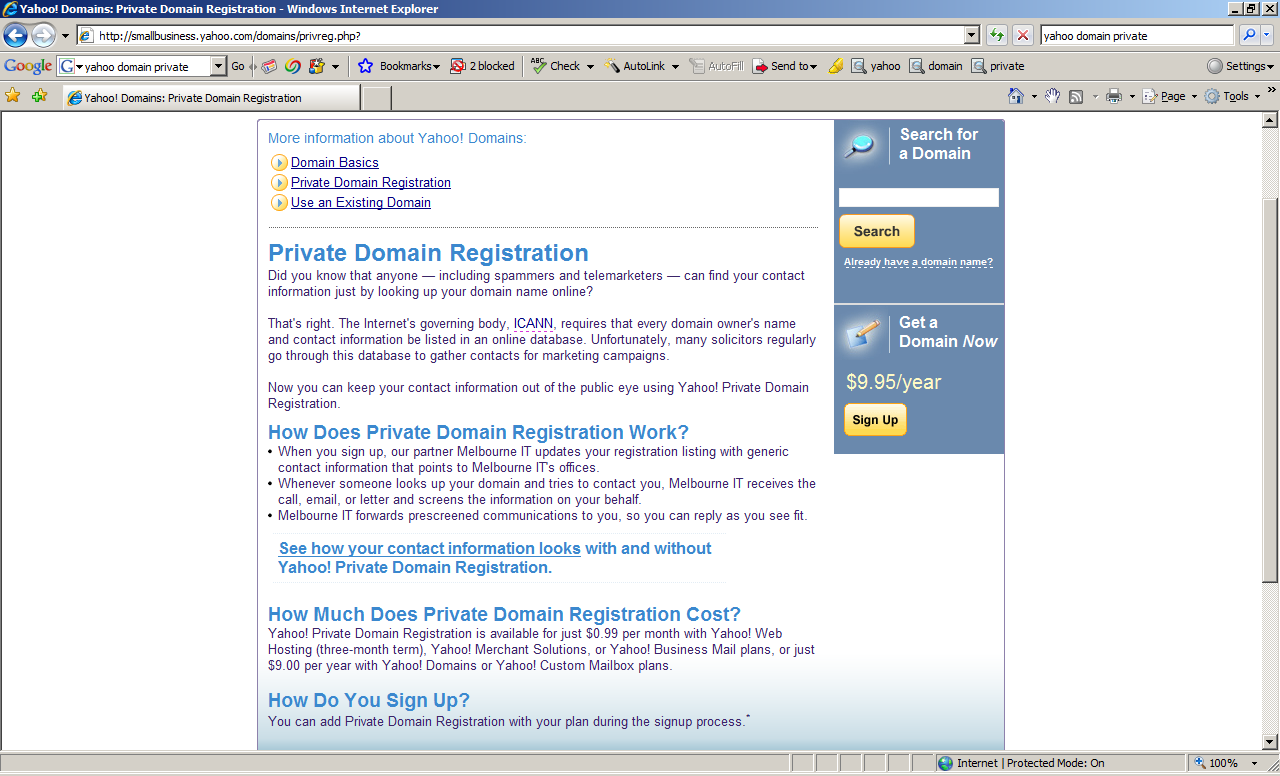
You’ll notice that the admin email address in the information Yahoo provides is contact@myprivateregistration.com. Now, on itspage (screenshot) describing the private registration service, Yahoo says


* When you sign up, our partner Melbourne IT updates your registration listing with generic contact information that points to Melbourne IT’s offices.

* Whenever someone looks up your domain and tries to contact you, Melbourne IT receives the call, email, or letter and screens the information on your behalf.

* Melbourne IT forwards prescreened communications to you, so you can reply as you see fit.

Okay, now think about this for a second – as I obviously didn’t, once upon a time. That one, single email address appears in the WHOIS data of every single person who uses this service. And they’re saying they’re going to forward your stuff to you. How are they going to do that?

You can’t hack together a Perl script for this. Actual human beings would have to read every single email to figure out who they were for – something no one wants happening to their private correspondence, particularly someone signing up for a privacy service. This would take hundreds of actual human beings, working full-time.

So what they claim they’re doing makes no sense, particularly given that there is an extremely cheap, simple alternative – giving every domain an individual forwarding address. The only thing cheaper and simpler would be never to forward anything at all. Logically, what must be happening is that they never forward anything at all.

They don’t. When you email that address, you get an email back saying


THIS IS AN AUTOMATED MESSAGE – DO NOT REPLY

You are attempting to contact a domain name that is protected by “My
Private Registration” service.

To ensure that your message is delivered to the administrative contact
you will need to complete the form at the following web site.

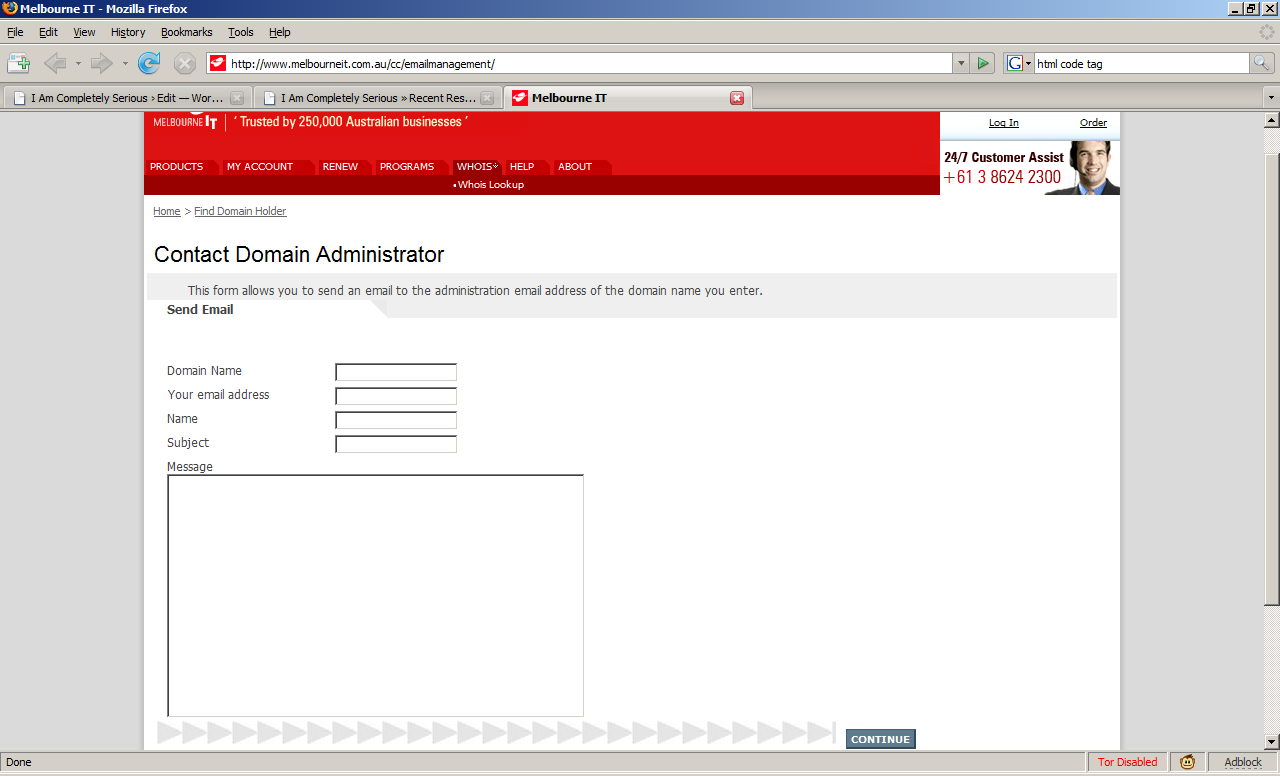
http://www.melbourneit.com.au/cc/emailmanagement/

You will need to submit the following information:

* Your Name & email address

* Your Message to the registrant

Regards

“My Private Registration” Team.

MelbourneIT and Yahoo’s communications seem to have broken down somewhere. MelbourneIT is not even maintaining the pretense.

That address takes you to an email form (screenshot). Upon clicking the “send” button, one is taken to a blank, broken-looking page (screenshot). I transferred my domain before discovering this, but haven’t yet canceled my subscription to Yahoo, so they still have my contact information on record. Emails I send to myself using this form do not go through. (I’d be interested in data from other people.)

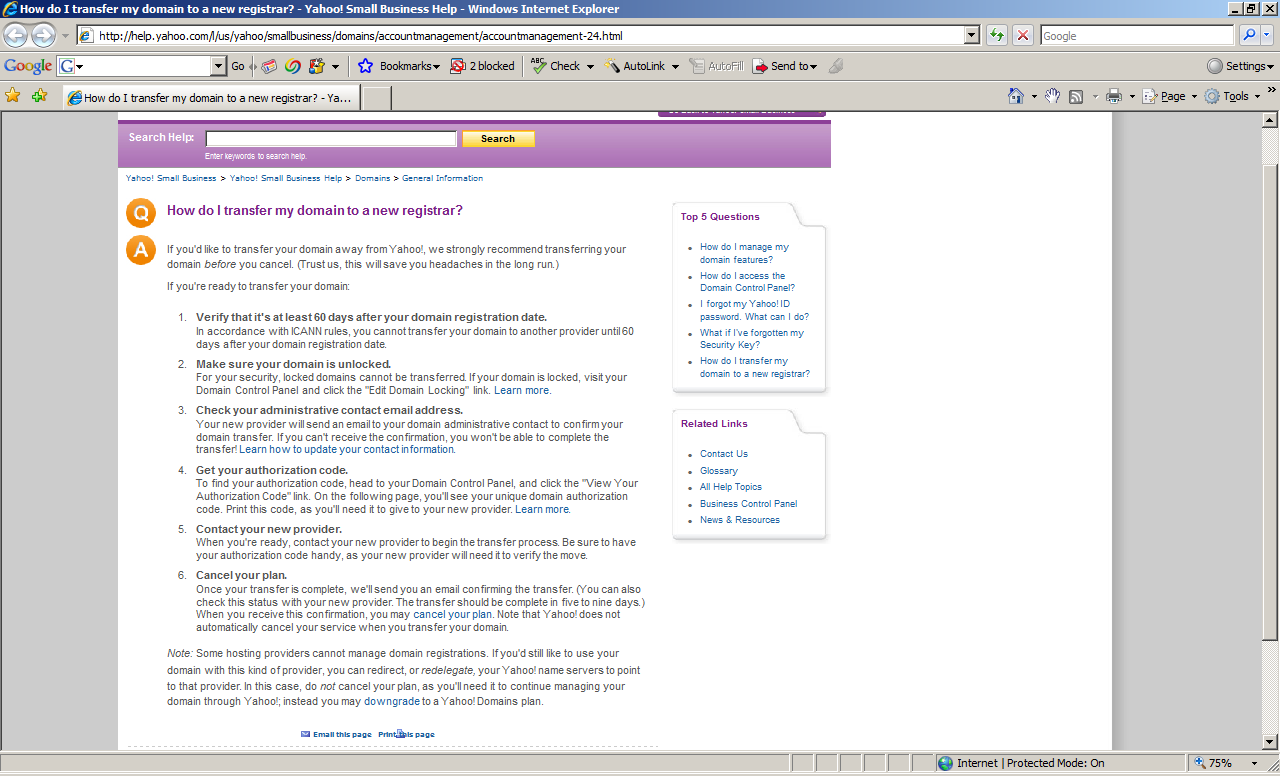
So. When you try to transfer your domain, the email the new registrar sends to contact@myprivateregistration.com goes into a black hole, making it impossible for you to conclude your transfer. Yahoo’s instructions (screenshot) for transferring a domain do not, as they should, mention this as a possible problem.

The only way to get a real email address into your WHOIS info, and thus transfer the domain, is to cancel the private registration service, making all your information public. Unless you choose to break the law (US law, anyway), and change some of your info to some made-up crap before canceling.

Even doing the latter, I’m not sure you could keep everything safe, as Yahoo doesn’t permit you to edit certain fields of your WHOIS data. When I first set up private registration on my domain, I found that my “Organization Name” field was still set to my real name. As I couldn’t edit the field, I had to file a support request to get them to change it.

Another option would seem to be to let the domain expire and then re-register it. However, expired domains tend to get bought up by scammers hoping to resell them to you at huge margins. If you want to continue using the domain, this isn’t a good idea.

It at least seems like it would be all right to let the domain expire if you decide you don’t want it anymore. However, according to this user of the service, Yahoo will, again, allow all your private information to get into the WHOIS database upon the expiration of your contract. This is particularly unsettling, as it seems logical that any remnant data left in the WHOIS database would be the last visibledata, that is, the MyPrivateRegistration.com data. This switch to the private data strikes me as something that would take actual effort on Yahoo’s part to implement.

Generally, incompetence is a safer bet than malice in technology failures. However, in this case, every action a user might take that would take his/her money away from Yahoo ends up revealing his/her private information. It’s really hard to see this as anything other than blackmail.

Saturday, July 14, 2012

Get More Traffic From Yahoo

With Yahoo! Pay-For-Review this model may be relatively easier to enter the site in the directory but you get traffic from the list of the entire story is different. And with the new annual recurring payment policy you must be extra careful when submitting your site for review. 

Here are 8 things to remember when submitting your site to Yahoo! 

1) Selecting your domain name is the most important step in getting top ranking in Yahoo! and also other directories such as Dmoz and Looksmart. 

Make sure your domain name is "Keyword Rich". You can make your domain keyword rich enough to enter hyphens to separate words in your domain name. Yahoo! provide more relevant to their site with keywords in the domain name. 

We take the domain name for example: http://www.home-based-business-opportunities.com/. This consists of 4 different in high-demand keywords: "Home Based Business", "Home Business", "Home Business Opportunities", "Home Based Business Opportunities." 

While the name of your domain, you should even try to keep your domain name, such as consisting of one, 2-4 word main or "parent" keyword, which in turn consist of 2-4 in high demand "child" keyword. You may or may not get the highest ranking for all keywords, but you can be sure to get a main or parent" keyword (If you do all the rights of others). Even if you must get a separate domain name for this, GET IT! This is really important for your ranking. 

2) Sites that are placed higher in the directory structure given more relevance of the site that placed a lower or depth.

For example a site that is listed in the category - B2B/Business Opportunities will give more relevance of a site that is listed in the category - B2B/Business Opportunities/Directories. Here's a great tip to select the category that most trafficked website for you.

Once you've short-listed 2 or 3 categories to place your site in, check the cost of the Sponsor Listing categories. It’s really simple. Visit the following URL: https: / / ecom.yahoo.com / fast / sponsor. Enter the URL of any web site listed in the category you want (must be the same as the URL that appears in a category must be commercial, and category).

Please note that Yahoo! Sponsors receive a listing only to certain commercial categories and so this tip may or may not work for the category. You will be prompted for your Yahoo! ID. After you submit your information, you will be given to the cost for a Sponsor. Repeat the process for the remaining short-listed categories.

Now compare the price of all short-listed categories. Natural that one with a higher price is one of the most trafficked!

3) Yahoo! considers keywords in the directory while the rank structure.

For example, if someone searches for "Directory of Business Opportunities", a web site listed in category -- B2B/Business Opportunities/Directories will give more relevance of the web site listed in the category - B2B/Business Opportunities

4) Yahoo! NOT a spider web to determine the ranking. It ranked sites based on keywords in the domain name, title and description. So having a META tag does not make any difference to your listing.

5) DO NOT try to stuff as many keywords into the description. Yahoo! editors cut down the information if they feel even the least hype. Try to avoid words like - no.1, proven, turnkey and fun etc.

Also, make sure that the titles of the same page with the information you give to your site. There is no confusion in the mind of editors’ review your site.

6) Make sure your domain name and business name is the same since Yahoo! known by using the business name as a title for your listing.

7) Make sure your website is "Content Rich". This is especially important for two reasons. One - to get your site received by Yahoo! and two - to maintain the list and get higher.

Yahoo! determines the popularity of a website by the amount of time visitors spend on your website. If you do not have that big, they hit the "back button" from their browser as soon as they hit your website, you can kiss up to your dreams may be higher than the list. Once you get a lower list, it can be very difficult to make as a visitor will not be able to find your site easily.

After getting a site accepted into the directory, Yahoo! ranking is based on the popularity of keywords in the domain name, title and description. But as time progresses, it is ranked based on the popularity of the website itself. We ignored this and we are listing down drastically in a few days after getting accepted!

8) Prior to the website, a website that actually research rank higher for keywords that you target (Especially the "Most Popular" sites in the directory). This will give you a rough idea about what should and what is not included in your website.